November 24, 2024 9:30 AM
It’s a frigid fall Friday night. Multi-colored leaves coat the ground, sticking to the bottom of shoes and trailing into the lobby of Griffs Georgetown Ice Arena. An aroma of freshly salted pretzels and decadent hot chocolate masks the stench from the equipment bags sitting in the lobby. The warm lobby defrosts your hands and toes from the chilling outside wind, yet opening the doors to the rink sends a shiver down your spine. As friends and family pile into the rink with their heavy jackets, junior captain Carson Wood tapes the end of his stick as the last step in preparation for the game ahead.
Grand Valley State University men’s hockey club was formed in 1974 as an avenue for students with a hockey background to continue their careers at the collegiate level. This year marks the fiftieth anniversary of the club team, which has undergone major changes since its birth. Previously, the team was under the American Collegiate Hockey Association (ACHA) and the Great Lakes Collegiate Hockey League (GLCHL) at the Division II ranking but transitioned to Division I in the 2020-2021 season; furthermore, the club doesn’t participate in the GLCHL, but now the Great Lakes Six Hockey Conference (GL6) and ACHA. Undergoing structural changes alters the competitive nature, traveling expenses, scouting, and schedule for the team. Another pivotal change for the Division I team is media coverage. In the 2024-2025 season, the Division I team gained major media coverage, which has impacted fan engagement, social media exposure, student learning opportunities, and the team dynamic. Currently, the team is halfway through the season with a record of 11-5. The team’s successes and media presence boils down to one woman on a volunteer basis, who is changing the mold of club sport media coverage, specifically for the men’s hockey club. Her impact and dedication to the Division I hockey team are altering the fan perception, drawing in recruits, transforming the team’s dynamic, and breaking down the historical media desert.
Grand Valley is home to 36 club sports teams under the recreational department with 700 student-athletes. As club athletes, these students don’t receive any scholarships or financial aid to assist their collegiate sports. All club athletes pay the full tuition to attend Grand Valley, which is 15,140 in tuition per year, with additional club fees to participate in the sport; furthermore, the price range for club fees is between $350-4,000 a year. Grand Valley provides some money to each club program, but it isn’t sufficient to fully support the team, which entails the players paying hefty club fees. Grand Valley’s Division I hockey team pays the higher end of these fees because of the reserved ice time, travel costs, and high equipment. According to Flo Hockey, the average total cost, just to simply play the sport is between $2,077-8,180. To play on Grand Valley’s Division I hockey team returning players pay $3,000 and first-year players $3,500. Compared to other club sports at Grand Valley this figure is on the higher end of club fee dues. Due to Grand Valley considering the hockey team as a club, these athletes endure the financial burden while competing at a high level against teams that are considered varsity sports. Director of Hockey and Division I head coach Matthew Sekosan contextualized where Grand Valley stands in the GL6 conference.
“We are the only team that is not under its school athletics department, along with being the only team with players paying season dues to have the team operate,” stated Sekosan. “All other programs are fully funded by the university, including all ice needs, travel, equipment, meals, and coaches’ salaries.”
Junior captain Carson Wood elaborated on the financial difficulties the team faces, as Grand Valley cut the hockey budget four years ago while playing against teams that are fully funded.
“We are one of, if not the only top 25-30 teams that aren’t fully funded,” stated Wood. “That can make things difficult, seeing how good and easy other teams have it.”
Due to the label of a club sport, Grand Valley doesn’t advertise, promote, or support these teams compared to varsity sports. On top of the financial burden, club athletes face another battle of promoting and advertising the team. Varsity sports receive media attention from the student newspaper, the Lanthorn, a third-party live-streaming service, FloSports, and Grand Valley social media platforms. Historically, the Division I hockey team only received media attention when they were successful in the league or when media personnel took an interest in the sport. Grand Valley’s student-run television network (GVTV) live broadcasted hockey games in 2014 called After the Whistle. GVTV would only run the live broadcasting when a game had a highly anticipated crowd, if the team was in the playoffs or a rivalry game, and if the media students had an interest in hockey. For example, when the Division II (at the time) team played Michigan State’s DII team the event was called “Pack the George,” this event was broadcast every time because of the anticipated crowd and the classic matchup. Similarly, The Lanthorn would send a sports writer to cover games when the team was in the playoffs or successful. Griffin Missant has been a writer at the Lanthorn for the last two years and covered three games for the Division I hockey team last season. Missant expressed the coverage was out of the norm but desired by the editor, at the time, to “cover some of the sports we didn’t normally do.” The game coverage was at the end of the regular season, at the height of the team’s success. Missant commented on the Lanthorn’s coverage of club teams compared to varsity athletics.
“I do believe they (the Lanthorn) focus on varsity sports out of sheer popularity,” said Missant. “I do think we focus more on varsity sports but it’s just because that is what the audience and readers want to know about. However, I think club sports do still get a reasonable amount of coverage.”
While varsity sports have higher popularity than club sports, is that an excuse for coverage? Gaining popularity calls for promotion, advertising, support, and funding. Without the proper foundation in promotions and advertising, how are teams like Grand Valley’s Division I hockey team supposed to gain popularity?
The inconsistent media coverage forced the hockey club to rely on self-promotion by word-of-mouth communication, which created a vicious cycle. How should the team promote themselves with no social media presence or assistance from the university? Relying on word-of-mouth communication entailed hockey players promoting games personally and hoping for a trickle-down effect of communication. This method wasn’t effective as it only circulated and relied on a small demographic and wouldn’t generate consistent foot traffic, causing minimal support that didn’t put bodies in the stands. On July 8th, 2016 the team created a social media account, as another avenue to improve advertising and promotion. However, the social media presence was run by the coaching staff, who had no experience with digital marketing or promotion. The lack of advertising and promotion affects the recruiting process, scouting, and funding. Sekosan expressed the correlation between media coverage and impacting the team.
“These are 100% correlated, with the digital age of content, Bri Slager and our players involved with it, continue to keep it on track, which has provided more consistency for our programs marketing,” stated Sekosan. “The marketing has helped us recruit and retain the talented players we have and are aiming to have in the future.”
The Gokhale Institute of Politics and Economics stresses the importance of media coverage in sports by stating, “The relationship between sports and mass media is intimate because media not only carves public opinion but also helps propagate it, thus promoting sporting events. Social media, sports broadcasting, sports journalism, and sports coverage influence and shape public perception of sports.” The historical media coverage that the Division I, at the time Division II, team received was lackluster and, in turn, prevented the program from growing and creating an identity. One woman was the determining factor for the growth of the program digitally.
Laker alumnus Slager started working for Grand Valley in 2016 running the social media page for the Club Sports and Recreation & Wellness department from 2016-2021. At the time, Slager’s brother, Nolan, was an assistant coach for Grand Valley’s DI hockey team and asked for assistance running their media page, gvsu_hockey. Slager took over the Instagram at the end of 2016 and the beginning the 2017 season, while continuing to work for the Rec Well at Grand Valley. She built the foundation upward by posting the team’s schedule, highlight reels, game photos, photoshoots, accomplishments, “hype videos,” etc. This created an identity for the team giving them exposure, fan engagement, and a presence. Compared to the past media coverage, Slager perpetuated the idea that teams should get recognition no matter their success or exposure.
“(Club) Student (athletes) are paying $1,000-4,000 a year to play a sport they love,” Slager said. “They shouldn’t have to win a national title to get a social media shoutout.”
Slager’s portfolio and skills determined how the media page was run; furthermore, she has an Associate’s degree focusing on Graphic Design from Ferris State University and a Bachelor’s degree in Marketing from Grand Valley. Building the platform upward, Slager set the standard for media coverage. The 2024-2025 Division I season has been the most successful year, in terms of media coverage, to date. This hockey season, beginning June 29th, the Grand Valley Instagram page reached 107 posts as of December 7th; furthermore, these dates are only halfway through the hockey season and the total number can be projected to double by the end of the season. In comparison, the archival pictures on Instagram in 2016 only have 28 posts from the same time frame. Slager has composed a group of multi-media students to bring different elements to the page, exponentially affecting attention and attraction. Recruiting for the team is based on attraction and attention. In the 2024-2025 season, the team has obtained eleven new players, last season it was just six.
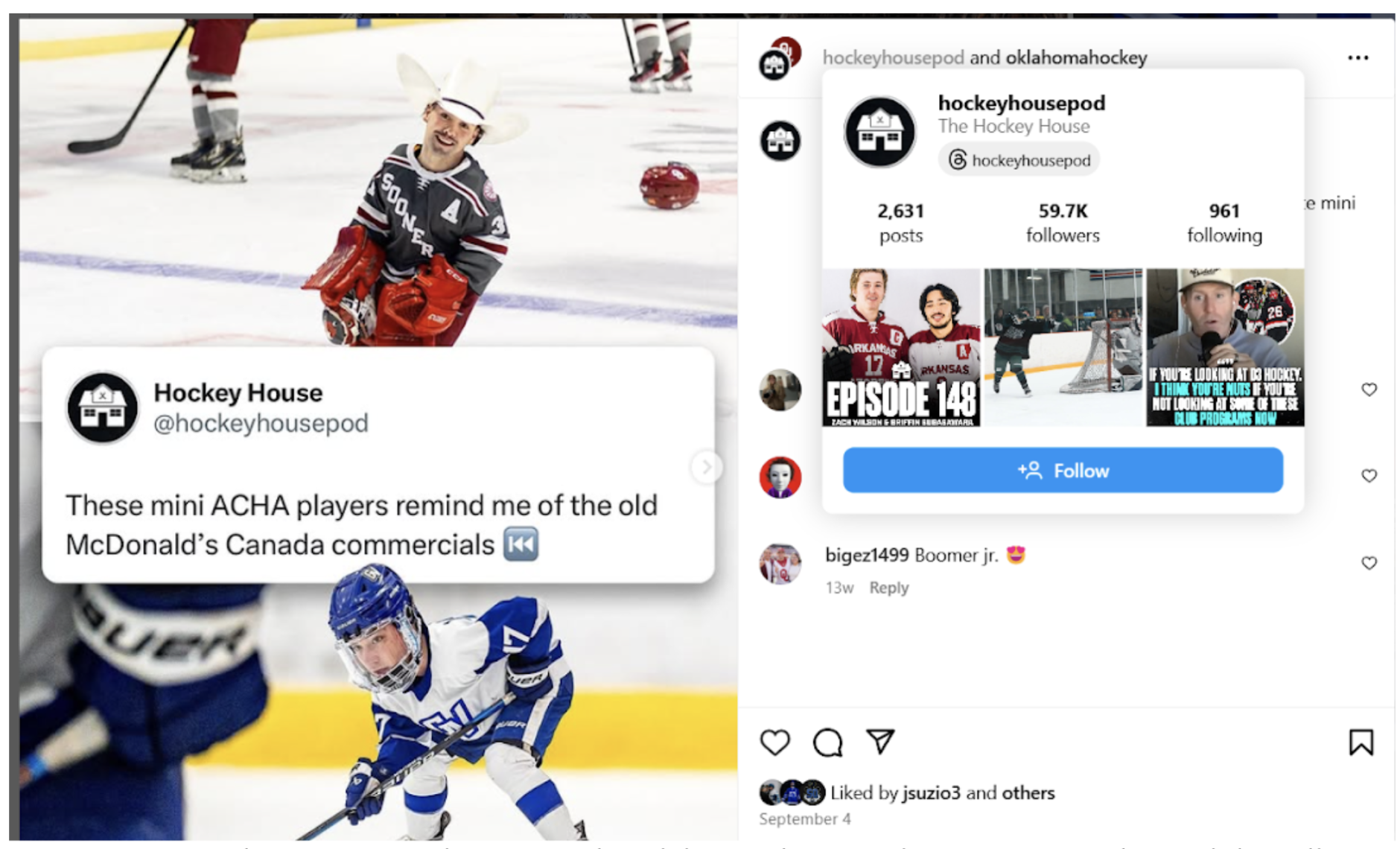
Social media attention is directly correlated with recruiting and brings attraction to the team. Currently, the Instagram page has 4,203 followers and is formatted using different multimedia techniques. Ben Bruce is a senior pursuing a film and video major at Grand Valley, producing high-end video clips of games and “hype videos” for the team. Emma Graham is a current Grand Valley student majoring in photography and minoring in advertising and public relations, producing quality photoshoots and in-game photography from the team. The dynamic trio captures multiple media elements surrounding the game of hockey but also focuses on building character for each player and the overall team. While accomplishing successful media, building personal connections with the team, and growing the hockey platform, Bruce, Graham, and Slager face the harsh reality of assisting a club sport, as they don’t get paid.
In any job field, you are paid for the work, but if you do what you love then you receive two forms of compensation; the accomplishment of finishing a project you love and getting paid for it. Grand Valley’s Division 1 “media team” all work freelance, which forces them to use personal equipment and time out of their day to shoot, edit, and attend games with no compensation. From the team’s perspective, already undergoing financial burdens eliminates the possibility of compensation. However, the majority of the team has expressed their indebtedness and appreciation for the trio.
“Bri, Ben, and Emma are insanely helpful to our organization!” expressed Avoletta. “I can’t even begin to explain how much of an impact they have. Without them and our social media presence, we would have fewer recruits, less fans, and less support. Not only do they put out a great number of posts, but they’re very high-quality posts, pictures, and videos.”
It is clear that the team would compensate the trio if they could. Even as the work is freelance, the trio simply does it for the love of the game and treats it as a learning experience. Sports media is hard to master and takes time to excel. In a high-paced game, understanding the shutter speed of a camera or even simply anticipating a goal by reading the ice takes time to develop those skills. Graham elaborated on her experience working with the team and how it has been a learning experience for her.
“I loved my time with this team, so far. I have grown a lot in my skills over the past few months!” stated Graham. “I am beyond grateful for the opportunities I’ve had with this team and look forward to what the future holds.”
Covering any sports games is a great learning experience and an opportunity for film, photography, and journalism students to get hands-on time outside the classroom.
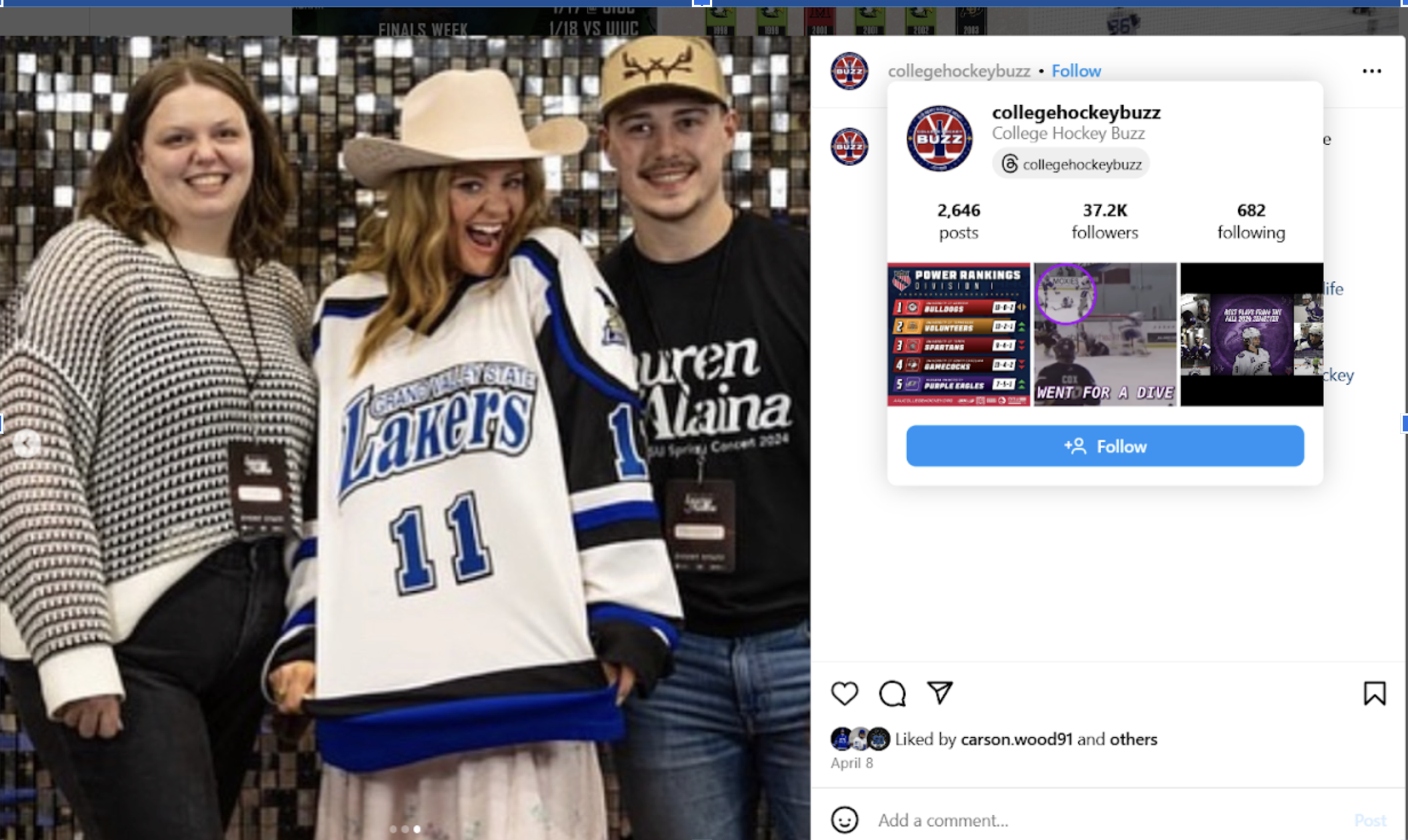
The 2024-2025 hockey phenomenon has stretched the boundaries of current fan engagement, the team’s dynamic, and exposure. With the rise of social media from the success of the trio, the hockey team has seen a steady increase in popularity. Senior captain Josh Suzio has been on the team for the last four years and has seen first-hand how the media presence has affected the crowd.
“The media presence from my first year to now is the biggest difference I’ve seen in my four years,” stated Suzio. “It’s light years away from how we conducted ourselves the first year and has greatly impacted not only our busier games (projected crowds) but overall attendance for each game.”
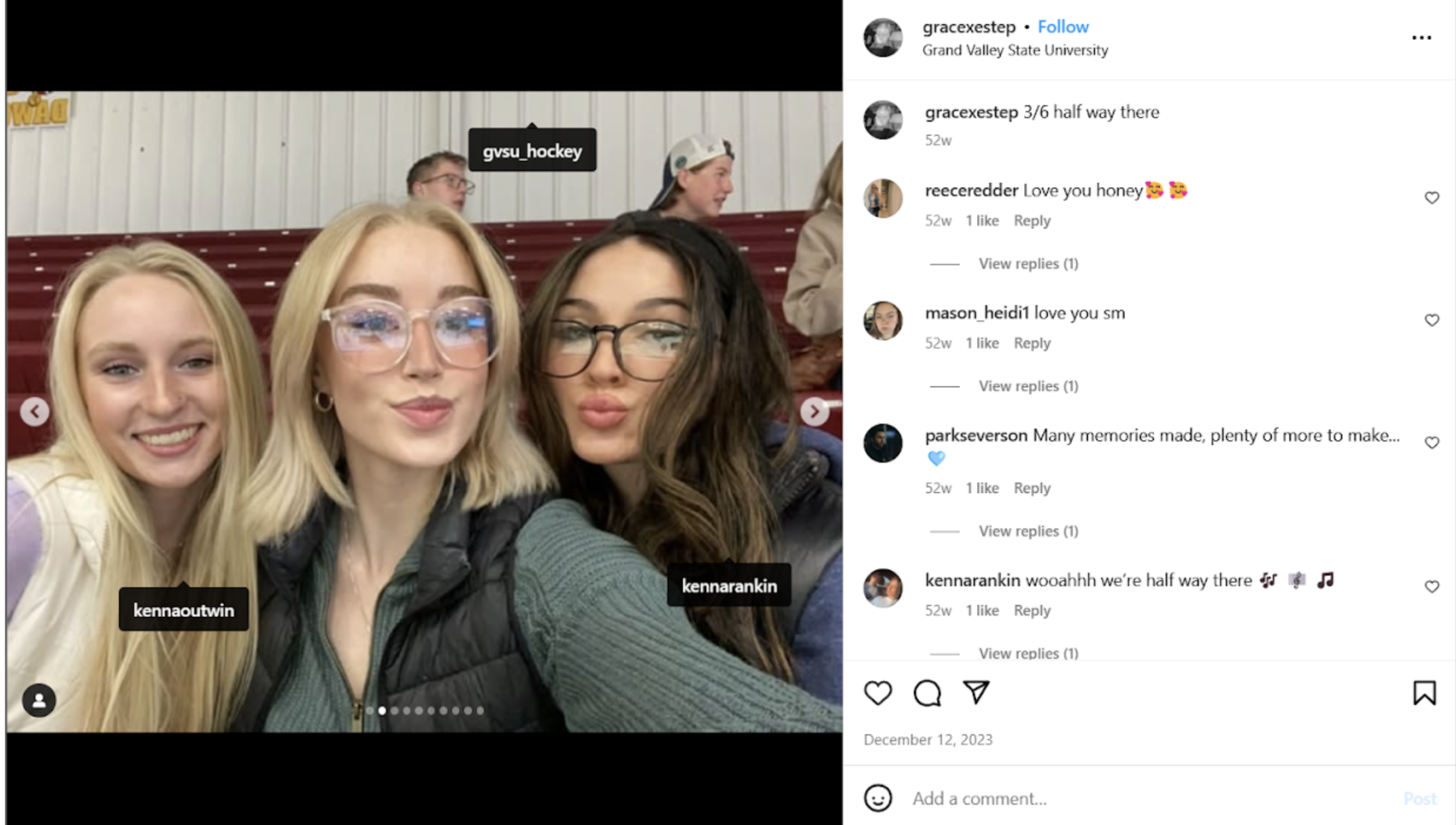
Grand Valley students attending a game and tagging them
According to head coach Sekosan, the hockey program at Grand Valley has and continues to be unable to track attendance. This is due to a lack of resources from the university such as; staffing and ticketing sales resources. Without a formal ticketing system in place to track attendance, there is no quantitative data, only empirical. However, the general consensus from players, coaches, media students, parents, and reoccurring fans is an apparent increase in attendance. Sekosan elaborated on the desire for a tracking and formal ticketing system but expressed that it is “currently not in our means to have it done consistently for the teams.”
The crowd impacts the team by giving them someone to play for and providing sensational energy in the rink. Media helps with exposure and brings fans into the benches, but the team keeps them coming back for more. Hockey is a highly competitive, intense, physical game for true entertainment. Wood, the captain, observed that there is a correlation between crowd size and media coverage, adding that a crowd impacts the team.
“A crowd definitely impacts the way we play, it makes it so much more exciting and you can feel the energy in the rink when there is a big crowd,” he said.
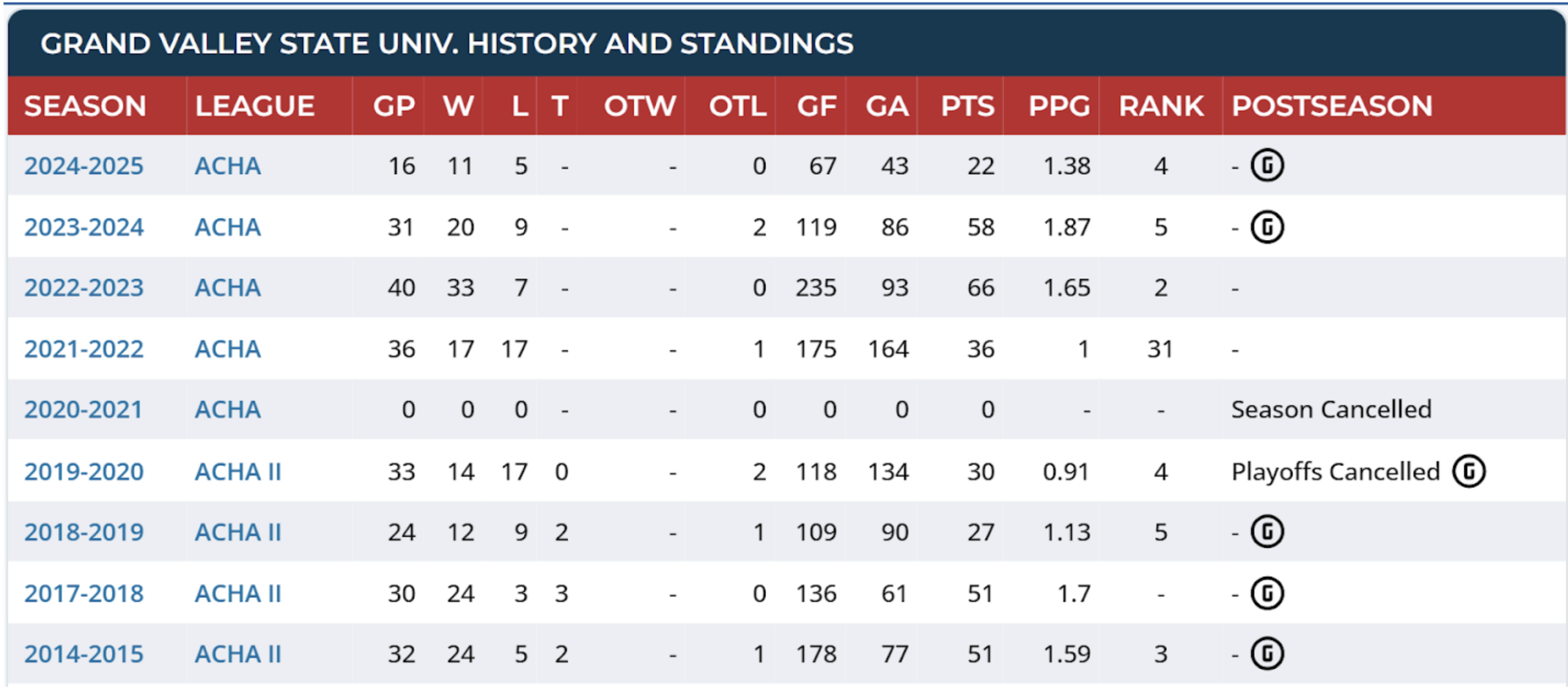
According to EliteProspects, the official database for the team, in the last three years the team has played exponentially better. With the initial implementation of the social media account in 2016 the team was successful in the prior 2017-2018 season; furthermore, the 2018-2019 team won the MCRHL Division II Conference Championship. From the 2019-2022 seasons, the team’s overall record declined. Head coach Sekosan named this decline as the “COVID era boys” who had experienced failure in terms of losses and unfulfilled seasons. As Sekosan stepped in as head coach in the 2022-2023 season and the media presence from Slager increased, the team steadily played better.
Increasing fan engagement while simultaneously increasing the team’s dynamic creates a healthy environment and expands the program for numerous opportunities. Avoletta also commented on fan engagement and how the crowd has grown over the last three years he has played on the team.
“There has been a huge increase in the consistency of fans,” stated Avoletta. “My freshman year, a game on Saturday at 4:30 P.M. would be empty, but now we have a 75% full set of bleachers. It’s been awesome seeing the program grow, and it makes the boys want to get even better for our fans.”
Grand Valley’s hockey phenomenon proves the importance of media convergence in sports. Social media coordinator Slager reflected on how the trio’s work has impacted not only the team, Emma and Ben, but also Grand Valley as a whole.
“It’s created excitement on campus and for incoming students. I hear comments all the time on how the media coverage makes the athletes feel seen and supported. It’s great for Emma and Ben’s portfolios too.”
 Tori Byrne Portfolio